
THE QUIET YEARS
You built something real. You performed, documented, followed every rule — and still lost it. This work was written for that exact experience.

Rebuilding Trust in Yourself
A Bridge Between Collapse and Clarity (2013–today)

You built something real. You performed, documented, followed every rule — and still lost it. This work was written for that exact experience.
The Quiet Years is a field manual for reading the architecture beneath business outcomes before that architecture shows you what it was designed to allow. The frameworks inside were built from a $3M project — court-ordered discovery, federal investigation, forensic accounting — because that level of documentation is what it took to prove the pattern was architectural, not personal.
You are a founder, a borrower, a builder who did everything right. You are fighting to save what you built, or you have already lost it and are still trying to understand why.
This is not a recovery story. It is a diagnostic. The difference matters — because what you need right now is not consolation. It is explanation.
Who This is For
You did everything right.
The outcome still went wrong.
You are the founder who executed well and lost anyway. Who built something profitable, something documented, something real — and watched someone with authority over the record rewrite what that performance meant. The specifics differ. The architecture is identical.
You are the entrepreneur who looked at the outcome and could not reconcile it with the execution. Who kept searching for the mistake you made, because the alternative — that the architecture was designed to extract, not protect — was too large to process alone.
This work names what happened. Not as grievance. As architecture. Six frameworks, built from a documented federal case, that make the invisible visible — before it costs you everything, or after it already has.
And if you are a journalist, researcher, or educator who needs a documented case study of institutional extraction — with court-ordered evidence, forensic accounting, and Congressional correspondence behind every claim — this work was built for that purpose as well.
THE SIX FRAMEWORKS
Six ways to read what institutions allow
before they show you.
1: Pressure Testing
How systems reveal their true design under stress
Every institution performs neutrality until pressure is applied. The hallway principle — same action, different outcomes depending on who is watching and who controls the record — shows how interpretation authority determines results long before evidence enters the room. Learn to see the structure the moment strain appears, not after it has cost you something.
Chapter 1: Learning to See Structure
2: Documentation as Infrastructure
Turning lived experience into evidentiary protection
Recording what happened is not journaling. It is construction. The act of creating a contemporaneous record transforms personal collapse into protective architecture — evidence that outlasts institutional memory, that cannot be revised by whoever controls the official account. Narrative becomes your permanent record when nothing else will be.
Chapter 2: Narrative as Infrastructure
3: Information Asymmetry Audit
Mapping who sees what — and who controls the official record
When a single intermediary controls what multiple parties see, contradiction can persist without detection indefinitely. Two letters. Same date. Same author. Incompatible claims. No mechanism required reconciliation because no mechanism existed to surface the conflict. Know how to spot partitioned truth before it partitions your reality.
Chapter 3: The Architecture of Information Asymmetry
4: Interpretation Authority Mapping
Tracking discretion as the real decision mechanism
Evidence proves only what the interpreter allows it to prove. Forensic accounting that is mathematically irrefutable can be sealed from public record. A performing loan can be reclassified as adverse through a single discretionary determination. Find the interpreter — and understand the scope of their discretion — before they find grounds to reinterpret you.
Chapter 4: Interpretation Authority and the Illusion of Neutral Rules
5: Verification Architecture
Designing infrastructure where proof outranks permission
Centralized record-keeping creates the structural conditions for both information asymmetry and interpretation authority to concentrate in the same hands. Six design principles determine whether the infrastructure you build inside can protect your work — or will partition it the moment incentives diverge. The vulnerability is observable before you commit, if you know what to look for.
Chapter 5: Verification Architecture
6: Structural Agency
Building differently after you can see what failed
Knowing what failed is the beginning. The final framework translates diagnostic clarity into architectural choice — how to evaluate every financing structure, platform relationship, and institutional agreement for where interpretation authority concentrates and who controls the record when outcomes diverge. Not all centralized structures extract. But you can see the architecture before collapse shows it to you.
Chapters 6–10 and Epilogue — publishing now
READ THE QUIET YEARS
Ten chapters.
Start anywhere you recognize yourself.
Prologue: The Corner
What a derelict building on a dying street taught me about seeing what everyone else had already written off.
Chapter 1: Learning to See Structure
Every institution looks neutral until you watch how it behaves the moment pressure is applied. This is how you learn to watch.
Chapter 2: Narrative as Infrastructure
The record you build while it is happening becomes the only record that cannot be revised by whoever controls the official account.
Chapter 3: The Architecture of Information Asymmetry
Two letters. Same date. Incompatible claims. No mechanism required reconciliation — because no mechanism existed to surface the conflict.
Chapter 4: Interpretation Authority and the Illusion of Neutral Rules
Rules are not neutral. They are neutral until someone with discretion decides what they mean. This chapter maps where that discretion lives.
Chapter 5: Verification Architecture
Six design principles for choosing infrastructure where the record cannot be revised by whoever has the most to gain from revising it.
Chapters 6: The Middle Space As Method
Seven years between collapse and re-emergence looked like waiting. They were the systematic practice of learning to see architectural vulnerability before building inside it. Seven questions that change what you ask before you commit.
Chapter 7: Before You Commit
The banker expected fear to do his work for him. It didn't. Not because of courage — because of literacy. This chapter builds the three capacities that let you see architecture clearly before you are inside it.
Chapter 8: Rebuilding Inspirador — From Survival to Design
I refused to release her into architecture that would extract her again. Four design principles that emerged from twelve years of holding onto what collapse made visible — and building it back in structure that protects rather than takes.
Chapter 9: Orientation — Moving Through Architecture Without Losing Yourself
Architectural literacy surfaces a fear no one warns you about: seeing too much to move. Four axes that transform paralysis into navigation — and keep you from losing yourself inside systems you didn't design.
Chapter 10: Architectural Responsibility—The Systems You Create Will Outlive You
Every builder eventually becomes a system designer. The question shifts from how to stay oriented in systems you didn't design to what your design choices will allow, constrain, protect, or expose for everyone who builds inside what you create.
Epilogue: Building From Proof
Not optimism. Not resilience. Clarity. The canon that emerged from collapse is not a memorial to what was taken — it is the architecture of what comes next.
THE $3M CASE
CDC President Robert D. McGee falsified loan certifications — understating the recorded loan amount by $250,000 — to manufacture grounds for foreclosure on a performing business. A federal investigation cleared Dilia Wood of all wrongdoing. McGee subsequently resigned.
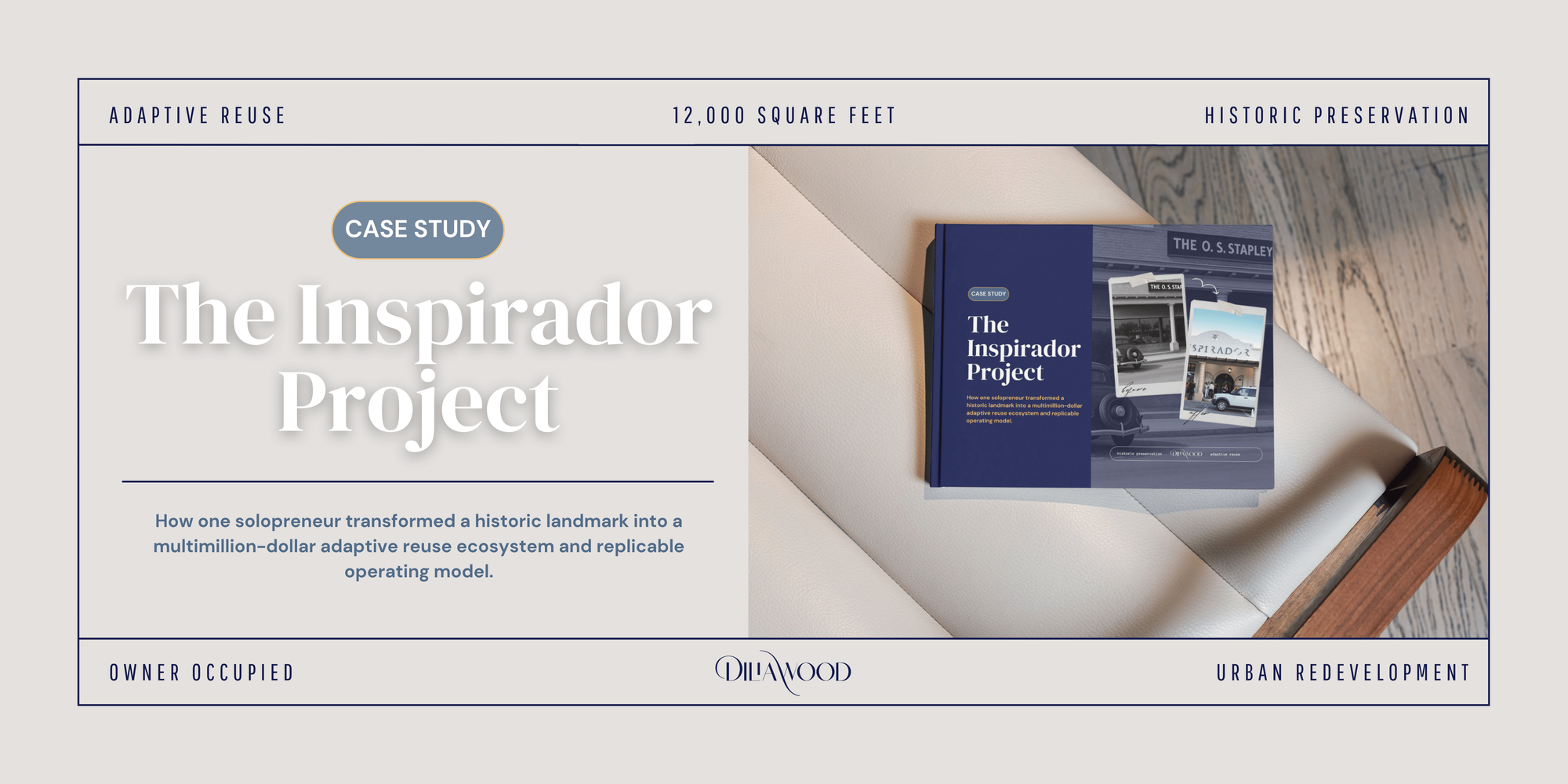
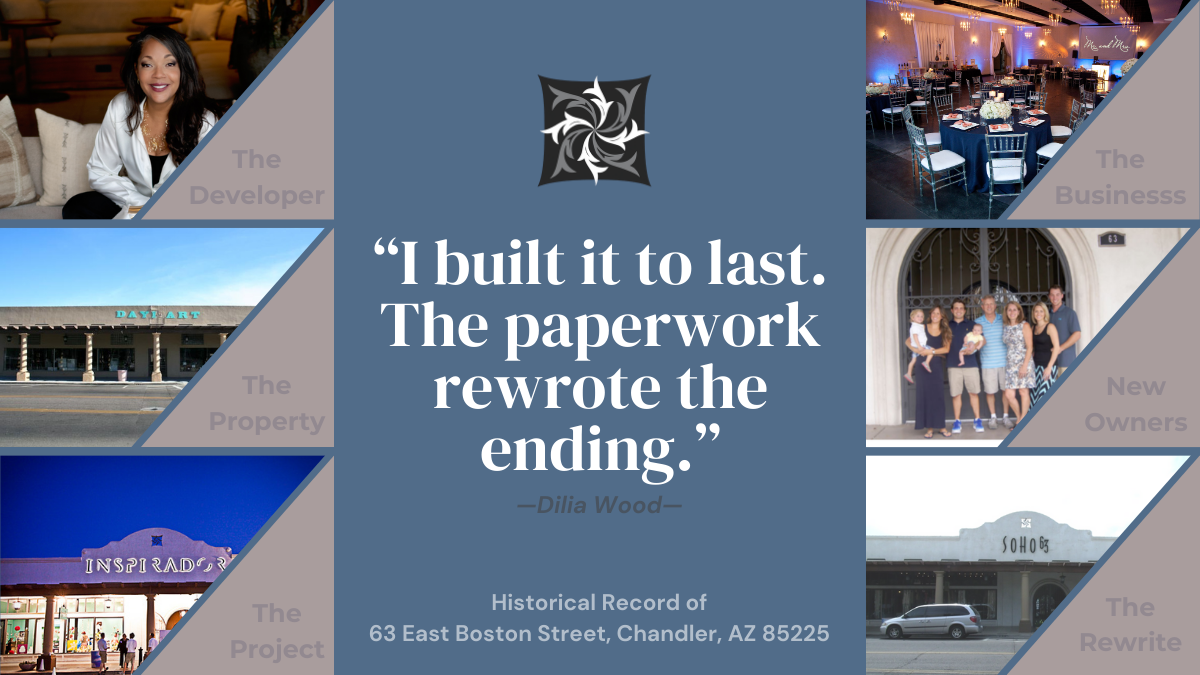
That is not the beginning of the story. It is the forensic conclusion. The beginning was 2006, when Dilia Wood acquired the 1924 O.S. Stapley Hardware Store at 63 East Boston Street in Chandler, Arizona — an abandoned 12,000-square-foot landmark that every conventional assessment had written off as non-viable.
Through SBA 504 financing, she transformed it into Inspirador: a profitable adaptive reuse venue that earned unanimous City Council approval, survived the 2008 financial crisis without modification, and operated on an 18-month booking waitlist. The project performed by every measurable standard the loan agreement required.
Court-ordered discovery later revealed what performance could not protect against: a coordinator who controlled the information flow between borrower, lender, and SBA simultaneously — and who used that position to partition the record in ways that took years of forensic accounting to surface.
The frameworks in The Quiet Years were built from that record. Every pattern named in these chapters is documented. Every claim is evidenced. This is not theory drawn from observation. It is architecture reverse-engineered from what the forensic record proved.
The Inspirador Story → · Two Sets of Books → · The Inspirador Case Study → · Historical Record →
Full case documentation:
The Inspirador Story
Two Sets of Books
The Inspirador Case Study
Dilia Wood
Founder · Developer · Historic Preservationist
Dilia Wood acquired the 1924 O.S. Stapley Hardware Store — a designated historic landmark in downtown Chandler, Arizona — in 2006 and transformed it into Inspirador, a profitable adaptive reuse venue whose business model continues to operate today as SoHo63 under subsequent ownership.
At the time of loan closing, the CDC represented her SBA 504 loan as the largest in the country for a start-up business. What the forensic record revealed afterward became the foundation of this work.
She writes these frameworks for founders who are mid-commitment, pre-signature, or already in the fight — because the architecture that failed her is still operating, and the people inside it deserve to see it before it costs them everything.
Dilia Wood developed these frameworks from the forensic record of the Inspirador SBA 504 case at 63 East Boston Street, Chandler, Arizona — documented through court-ordered discovery, federal investigation, and expert forensic accounting by Certified Fraud Examiner Marie McDonnell.